How the Post Office Created America: A History by Winifred Gallagher
Author:Winifred Gallagher
Language: eng
Format: azw3
ISBN: 9781594205002
Publisher: Penguin Press
Published: 2016-06-28T00:00:00+00:00
12
THE GOLDEN AGE
Messenger of Sympathy and Love
Servant of Parted Friends
Consoler of the Lonely
Bond of the Scattered Family
Enlarger of the Common Life
Carrier of News and Knowledge
Instrument of Trade and Industry
Promoter of Mutual Acquaintance
Of Peace and of Goodwill Among Men and Nations
—“The Letter,” by Charles William Eliot, as revised by President Woodrow Wilson. Inscription from the façade of the Smithsonian National Postal Museum, in Washington, D.C., formerly the city’s main post office and the companion building to Union Station.
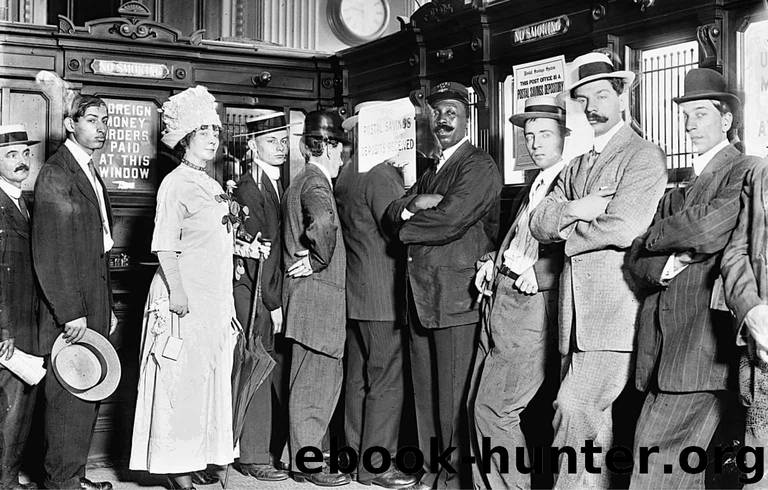
THE POST’S DYNAMISM and centrality to America’s public and private life were most fully realized between 1880 and 1920. During these glory days, the institution’s success in bringing more public services to many more people both supported and reflected an America that was tapping the riches of its vast West, moving to the center of the international stage, and exulting in its position as the world’s leading industrial powerhouse—all achieved in little more than a generation. Yale University’s president Arthur Hadley had to agree with the sentiments his institutional rival Charles William Eliot, president of Harvard, expressed in “The Letter,” his paean to the post. In Hadley’s opinion, “our whole economic, social and political system has become so dependent upon free and secure postal communication, that the attempt to measure its specific effects can be little else than a waste of words.” Cushing went further and used the language associated with Burke’s notion of the sublime to describe the post’s annual growth as “enormous, resistless, inconceivable,” proudly adding that “we beat the world.”
A few numbers suggest the turn-of-the-century post’s growth and scope. Between the Civil War era and circa 1890, the number of post offices doubled to 62,401. In 1860, the Railway Mail Service had operated on 27,000 miles of track, employed 600 workers, and cost $3 million per year; in 1891, it used 160,000 miles of track, had 6,000 employees, and cost $21 million per year. Between 1866 and 1891, registered letters increased in number from 275,103 to 15 million (with only 1 in 12,227 lost); the number of post offices that handled money orders rose from 766, producing $4 million in business, to 30,000, generating $140 million. Just between 1889 and 1892, the network added 8,120 new offices and 2,480 new routes and increased its revenue by 26 percent.
The postmaster general officially controlled this enormous business, but since Andrew Jackson’s day, he had also been much concerned with political matters. Four assistant postmasters general, who were in charge of post offices, transportation, finance, buildings, and other affairs, actually ran things on a day-to-day basis. Each of the Post Office Department’s many divisions, including money orders, dead letters, contracts, inspection, and foreign mail, was a major enterprise in itself. The Division of Supplies, for example, handled the entire department’s printed forms, stationery, ink, stamp pads, twine, scales, and so forth. (In 1890, this complex operation was under the command of the formidable Major E. H. Shook, a former “printer’s boy” who during the Civil War had fought in thirty-one battles, been taken prisoner, and escaped.
Download
This site does not store any files on its server. We only index and link to content provided by other sites. Please contact the content providers to delete copyright contents if any and email us, we'll remove relevant links or contents immediately.
| Africa | Americas |
| Arctic & Antarctica | Asia |
| Australia & Oceania | Europe |
| Middle East | Russia |
| United States | World |
| Ancient Civilizations | Military |
| Historical Study & Educational Resources |
Cecilia; Or, Memoirs of an Heiress — Volume 1 by Fanny Burney(32559)
Cecilia; Or, Memoirs of an Heiress — Volume 2 by Fanny Burney(31957)
Cecilia; Or, Memoirs of an Heiress — Volume 3 by Fanny Burney(31943)
The Secret History by Donna Tartt(19097)
Sapiens: A Brief History of Humankind by Yuval Noah Harari(14392)
Leonardo da Vinci by Walter Isaacson(13339)
The Radium Girls by Kate Moore(12033)
Sapiens by Yuval Noah Harari(5374)
How Democracies Die by Steven Levitsky & Daniel Ziblatt(5221)
The Wind in My Hair by Masih Alinejad(5097)
Homo Deus: A Brief History of Tomorrow by Yuval Noah Harari(4921)
Endurance: Shackleton's Incredible Voyage by Alfred Lansing(4785)
Man's Search for Meaning by Viktor Frankl(4608)
The Silk Roads by Peter Frankopan(4537)
Millionaire: The Philanderer, Gambler, and Duelist Who Invented Modern Finance by Janet Gleeson(4481)
The Rape of Nanking by Iris Chang(4217)
Joan of Arc by Mary Gordon(4116)
The Motorcycle Diaries by Ernesto Che Guevara(4105)
Stalin by Stephen Kotkin(3970)
